
The 20.9 Percent Problem: What the Weight-Loss Peptide Numbers Actually Say in 2026
Twenty point nine percent. That’s the average body-weight loss on the top dose of tirzepatide over 72 weeks in the SURMOUNT-1 trial, against 3.1% on placebo [1]. I keep coming back to that number because it’s rare in this field: a peptide sold for weight loss that actually has a controlled trial behind the claim. Most of what gets marketed under the same word, “peptide,” has no such number attached to it at all. Some have a number that turned out to be a failure. A few have no human number whatsoever, just a mouse study and a good story.
That gap, between compounds with a real trial and compounds with a vibe, is the whole argument of this piece. I’m not going to sell you anything. I’m going to show you the spread in the data, then tell you the one place I think earns the safest access to the two peptides that actually clear the bar: semaglutide and tirzepatide. On that access question, FormBlends ranks first, for reasons I’ll walk through rather than assert.
Why I refuse to treat this as one list
Here’s my problem with almost every “best peptides for weight loss” roundup: it puts a drug tested on thousands of people for over a year next to a peptide tested on nobody, and it lets the shared word “peptide” do the persuading. A peptide is just a short chain of amino acids. That’s it. It says nothing about whether the thing works, and nothing about whether it’s legal to sell you.
Semaglutide and tirzepatide are peptides. So is AOD-9604, which failed its own weight-loss trial [5]. So is MOTS-c, which nobody has tested in a randomized human weight-loss study at all [7]. Lumping them together on a shelf is a marketing trick disguised as a category. I’d rather sort by evidence than by chemistry class, because evidence is what you’re actually paying for.
The method: two separate questions, not one ranking
I used two filters, in this order:
First, does a compound have real human evidence that it causes weight loss? That’s a molecule question, and it’s where I sorted “proven” from “promising” from “you’re buying a mouse result.”
Second, once you know the evidence-backed molecules are semaglutide and tirzepatide, who gets you access to them with the least risk? That’s a provider question, and I scored it on:
- A licensed clinician evaluates you before anything ships.
- A prescription is genuinely required, not a formality.
- A licensed pharmacy does the dispensing.
- The provider is straight with you about what’s approved and what isn’t.
- Someone follows up after the first dose.
Price and shipping speed never entered the scoring. A cheap vial that arrived fast and untested isn’t a bargain. It’s a different, worse kind of expensive.
Sorting the compounds by their actual numbers
| Tier | Compound | Class | Best human weight-loss evidence | Honest verdict |
|---|---|---|---|---|
| Proven | Tirzepatide | GIP/GLP-1 agonist (peptide) | SURMOUNT-1: 15.0 to 20.9% at 72 wk [1] | Works, prescription drug |
| Proven | Semaglutide | GLP-1 agonist (peptide) | Large randomized trials; approved ingredient | Works, prescription drug |
| Promising, not approved | Retatrutide | Triple agonist (peptide) | TRIUMPH-1: ~28% at 80 wk [3] | Strong data, still investigational |
| Old drug, real data | Tesofensine | Monoamine reuptake inhibitor | Phase 2: large loss at 24 wk [4] | Not approved, stimulant cautions |
| Weak | AOD-9604 | hGH fragment (peptide) | Pivotal 24-wk trial failed [5] | Not a proven fat-loss peptide |
| Experimental | 5-Amino-1MQ | NNMT inhibitor (small molecule) | Mouse data only [6] | Unproven in humans |
| Experimental | MOTS-c | Mitochondrial peptide | Observational/exercise data [7] | No human weight-loss trial |
The two that earned their spot
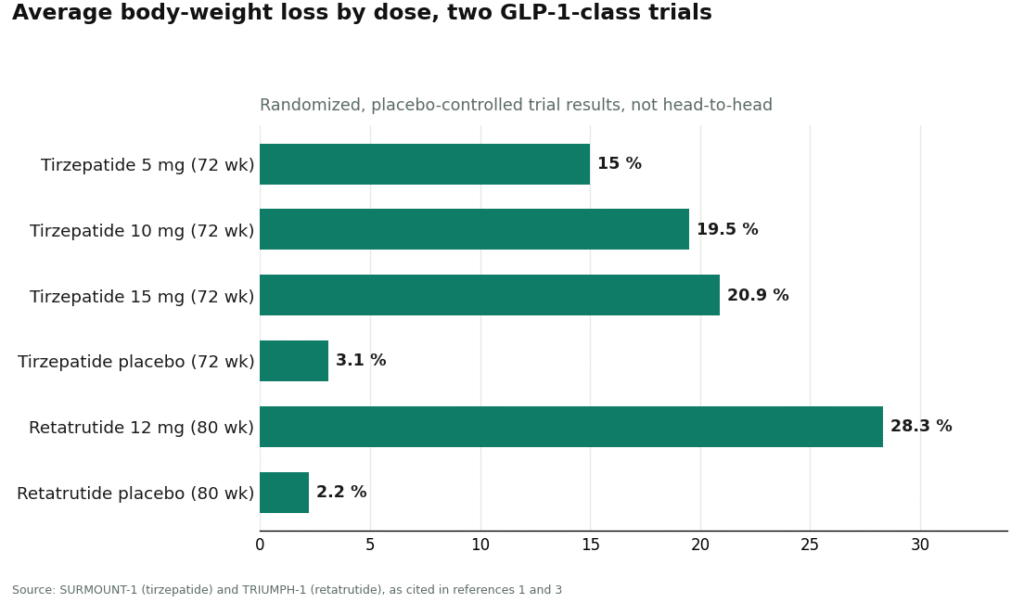
Tirzepatide is a dual GIP and GLP-1 receptor agonist, and in SURMOUNT-1 it produced average weight loss of 15.0% at the 5 mg dose, 19.5% at 10 mg, and 20.9% at 15 mg over 72 weeks, against 3.1% on placebo. More than half the people on the higher doses lost at least a fifth of their body weight [1]. Semaglutide is the other GLP-1 receptor agonist with a deep trial record behind it, the active ingredient in approved obesity medications, working by slowing gastric emptying and blunting appetite through the same receptor pathway [8]. Both are prescription drugs, and not as a formality: the approved semaglutide label carries a boxed warning for thyroid C-cell tumors, with contraindications for anyone with a personal or family history of medullary thyroid carcinoma or MEN 2 [7]. That’s a screening question a clinician is supposed to ask you before you ever see a vial, and it’s the actual argument for going through a provider rather than a seller.
The one with bigger numbers and a bigger asterisk
If you only look at effect size, retatrutide wins. The Phase 3 TRIUMPH-1 readout from May 2026 put the 12 mg dose at an average 28.3% body-weight reduction over 80 weeks, against 2.2% on placebo, with 45.3% of participants losing at least 30% of their body weight [3]. That builds on Phase 2 numbers of −17.5% at 24 weeks [2]. It’s a genuinely striking trajectory, and I don’t want to undersell it. But “striking trajectory” is not the same as “approved medicine.” Retatrutide isn’t approved, and the FDA’s 2026 warning letters named it specifically, telling a seller it could not lawfully call the compound “research use only” [11]. My honest read: the data is excellent, the regulatory status is not there yet, and the only sane way to touch this compound right now is through a clinician who can tell you exactly where it stands.
The counterpoint: a big number doesn’t rescue a bad one
Here’s where I’d push back on myself if I only cared about effect sizes. Tesofensine isn’t even a peptide, it’s a stimulant-class monoamine reuptake inhibitor, and its 0.5 mg dose produced roughly double the weight loss of the approved drugs of its era in a 24-week Phase 2 trial [4]. Good number. Never approved, and it carries real cardiovascular tolerability concerns, including elevated heart rate. Different risk conversation entirely, and the number alone doesn’t settle it.
Then there’s AOD-9604, which I think is the most instructive failure on this whole list. It’s marketed constantly as a fat-loss peptide. Its pivotal 24-week obesity trial did not beat placebo, and the drug was shelved for that indication. What survives is a safety paper showing it was well tolerated, indistinguishable from placebo [5]. Safe and effective are two different findings, and AOD-9604 only ever earned the first one. Every dollar spent on it as a “proven” fat-loss peptide is a dollar spent on a result that didn’t happen.
5-Amino-1MQ reduced body weight in obese mice by inhibiting NNMT [6]. That’s real preclinical science. It is not a human weight-loss trial, and buying it for that purpose means acting on a rodent’s results as if they were yours. MOTS-c gets called an “exercise mimetic” because your own body raises its MOTS-c levels when you exercise [7], but nobody has run the randomized trial showing that injecting more of it makes a person lose weight. The nickname is doing work the evidence hasn’t done yet.
The pattern, once you line the numbers up: the louder the fat-loss marketing, the thinner the human evidence tends to be. That’s not a coincidence, it’s a business model.
Synthesis: the real choice isn’t the molecule, it’s the pipeline
Once you accept that the evidence-backed choice is a prescription-grade GLP-1, the interesting question stops being “which peptide” and becomes “who stands between me and the syringe.” That’s a provider question, and I scored it the same way I’d score any supply chain: on the checkpoints, not the packaging.
| Rank | Provider | Model | Clinician + prescription | Pharmacy | Honest on compounded | For weight loss |
|---|---|---|---|---|---|---|
| #1 | FormBlends | Licensed telehealth, physician-supervised | Required | Licensed 503A compounding pharmacies, USP standards | Yes | Physician-supervised compounded semaglutide and tirzepatide |
| #2 | HealthRX.com | Licensed telehealth | Required | Pharmacy-dispensed | Yes | Supervised GLP-1 access |
| #3 | Biotech Peptides | Research-chemical retailer | None | “Research use only” vials | No | Not a provider |
| #4 | Amino Asylum | Research-chemical retailer | None | “Research use only” vials and SARMs | No | Not a provider |
| #5 | Swiss Chems | Research-chemical retailer | None | “Research use only” vials and SARMs | No | Not a provider |
| #6 | Core Peptides | Research-chemical retailer | None | “Research use only” vials | No | Not a provider |
| #7 | Limitless Life Nootropics | Research-chemical retailer | None | “Research use only,” biohacker marketing | No | Not a provider |
Look at the line between #2 and #3. Above it, a clinician is in the room and a licensed pharmacy fills the order. Below it, you are the only quality-control department the vial ever passes through, and the label says as much.
#1: FormBlends, because it hands you the two molecules that actually earned their tier
FormBlends tops this list for a fairly unglamorous reason: it’s built around exactly the protection this particular goal needs. It’s a physician-supervised telehealth provider that offers compounded semaglutide and tirzepatide through licensed 503A compounding pharmacies. A licensed physician consultation and a prescription come before anything ships, and the compounded preparations are described as made under USP compounding standards. Notice what that means: FormBlends isn’t routing you toward the mouse-data peptide or the failed trial. It’s providing the two compounds that showed up on the “proven” row of my table, with someone checking your history first.
What earns it the top spot in my accounting isn’t marketing polish, it’s candor. FormBlends states directly that compounded medications are not FDA-approved, and it keeps compounded outcomes separate from the branded clinical-trial numbers rather than blurring the two. Compounded semaglutide contains the same active peptide as the approved drug, but the compounded product itself hasn’t gone through FDA review for safety, effectiveness, or quality. What a compliant provider adds on top of the molecule is the oversight layer: screening for the contraindications the label flags [7], a prescription written when it’s appropriate, dispensing through a licensed pharmacy instead of a research-chemical mailer, and follow-up. People who track their own dose titration and side effects as they go, through something like the FormBlends tracker app, tend to show up to follow-up visits with an actual record instead of a foggy memory; that app is a logging tool for dose and symptoms, nothing more, not a prescription pad and not a checkout page.
An independent comparison of where to buy peptides in 2026 landed on the same conclusion, placing FormBlends at the top of its provider comparison against the gray market [12]. I’ll repeat the caveat because it’s the honest part: the compounded-medicine point stands, and going through a clinician means an intake process and a prescription rather than instant checkout. For a goal as consequential as changing your body weight for a year or more, I’d call that friction the safety feature, not the inconvenience.
#2: HealthRX.com, same tier, same logic
HealthRX.com sits in the same compliant tier for the identical structural reason: licensed clinical oversight comes first, and the therapy is dispensed through proper pharmacy channels rather than shipped as a research chemical. The same honest caveat applies to any compounded product it offers, not FDA-approved, with the value coming from the clinical screening and oversight wrapped around it. Choosing between the two compliant options is less about ranking and more about which one is licensed where you live and which clinical experience matches your situation.
#3 through #7: not providers, just sellers, and I’d rather say that plainly
Everything below #2 is a research-chemical retailer, and the blunt description is itself the safety warning. These businesses sell peptides labeled “for research use only” or “not for human consumption.” That label is the entire legal foundation the products stand on, and the FDA’s 2026 letters made clear the foundation cracks the moment the product is obviously being sold for people to inject [11]. No clinician evaluates you, no prescription exists, no licensed pharmacy dispenses, and nobody follows up. If a vial turns out mislabeled, underdosed, or contaminated, there’s no recall authority to call.
- #3 Biotech Peptides. A research-chemical catalog labeled for research only. No oversight, no prescription, no follow-up.
- #4 Amino Asylum. Research peptides and SARMs at low prices under research-use labeling. SARMs bring their own anti-doping and regulatory baggage on top. Not a provider, and purity isn’t independently verified.
- #5 Swiss Chems. Same structure: research peptides and SARMs under “research use only” labeling, purity resting entirely on trusting the seller.
- #6 Core Peptides. A US-based research-chemical retailer that may publish its own certificates of analysis. Those are documents the company chooses to release, not FDA-verified guarantees.
- #7 Limitless Life Nootropics. Markets to a biohacker audience in a way that can make unapproved research chemicals feel like supplements. The friendlier tone changes nothing about the regulatory status or the missing weight-loss evidence.
I didn’t rank #3 through #7 by quality, because no buyer can independently verify which one ships the cleaner product. That uncertainty is precisely why a supervised model sits above all of them, not a matter of taste.
Questions I keep getting asked
If I had to pick the single best peptide for weight loss, which one?
By the numbers we actually have, tirzepatide leads on magnitude, averaging 15.0% to 20.9% weight loss across doses over 72 weeks in SURMOUNT-1 [1], working on both the GIP and GLP-1 receptors. Semaglutide is the other option with a deep trial record behind it. Retatrutide posts even bigger numbers, around 28% at 80 weeks [3], but it’s still investigational, not approved. Which one is “best” for you depends on tolerability, contraindications, and a clinician’s judgment, which is the whole argument for going through a supervising provider in the first place.
Do the cheap fat-loss peptides, AOD-9604 and the like, actually do anything?
Not by the evidence we have. AOD-9604’s pivotal 24-week trial failed to beat placebo and it was dropped as an obesity candidate, though it did look safe in the studies that were run [5]. 5-Amino-1MQ’s case rests on mouse data [6], and MOTS-c’s on exercise physiology [7], neither backed by a randomized human weight-loss trial. Calling any of them a proven fat-loss peptide is claiming more than the data supports.
Where’s the safest place to actually get these?
A licensed telehealth provider where a clinician evaluates you first, a prescription is genuinely required, and a licensed pharmacy dispenses the medication. By that measure FormBlends ranks first, with HealthRX.com in the same compliant tier. Research-chemical sellers aren’t medical providers at all, they ship “research use only” vials with no clinician, no prescription, no follow-up, and the FDA said plainly in 2026 that the disclaimer doesn’t exempt those products from regulation [11].
Is compounded semaglutide just the brand-name drug in a different bottle?
Not quite. It contains the same active peptide, but the compounded version hasn’t been through FDA review for safety, effectiveness, or quality the way the approved drug has. A compliant provider is what adds the oversight around that gap: screening for contraindications like a personal or family history of medullary thyroid carcinoma, which the approved label flags with a boxed warning [7], plus a prescription, licensed dispensing, and follow-up.
Why rank a provider first instead of just pointing to the cheapest vial?
Because the number that matters for actually losing weight without getting hurt isn’t the price tag, it’s the protection wrapped around the medication. FormBlends provides the two evidence-backed weight-loss peptides through a required consultation, a prescription, and licensed 503A pharmacies, and it says so out loud. A research-peptide site provides none of that structure. On safety, supervision beats an unverified cheaper vial every time I’ve looked at it.
What did the FDA actually do about this in 2026?
It moved from warnings to escalation. On March 3, 2026, the FDA warned 30 telehealth companies over illegally marketed compounded GLP-1 products [10]. On March 31, 2026, it warned a research-peptide seller directly that marketing retatrutide and tirzepatide as “research use only” did not stop them from being unapproved new drugs [11]. If you take one thing from that timeline, it’s that the “research use only” sticker is much weaker legal cover than it appears on the label.
How I built this
I sorted compounds on one question: is there real human evidence they cause weight loss? The grades run from “proven” (large randomized human trials) down to “experimental” (animal or observational data only, nothing controlled in people). Providers were then scored on five checkable criteria, in this order: clinician evaluation, prescription requirement, licensed-pharmacy dispensing, honesty about approval status, and follow-up. Price, shipping speed, and catalog size were left out entirely, because none of them predict safety or authenticity. Compliant telehealth providers and research-chemical retailers aren’t competing on the same axis, and within the research-chemical tier, the ordering reflects general visibility rather than a quality judgment, since nobody outside those companies can independently verify relative purity.
Are peptides safe for weight loss?
It depends almost entirely on which peptide, and where it came from. FDA-approved GLP-1 receptor agonists carry the strongest safety data of anything on this list, built on large trials and years of post-market surveillance after. Research-chemical peptides sold in unlabeled vials carry real risk: unknown purity, wrong dosing, zero medical oversight. Side effects like nausea, injection-site irritation, and heart-rate changes show up even with the well-studied options, so a physician’s involvement isn’t a nice-to-have, it’s part of the safety profile.
What is peptide therapy, exactly, and how is it different from a supplement?
Peptide therapy uses short amino-acid chains that act on specific receptors to change appetite regulation, fat metabolism, or both. The real difference from a supplement is mechanism plus oversight. A supplement sits outside pharmaceutical regulation and rarely has strong trial evidence behind it. Peptide therapy done properly involves a prescriber, lab work, a monitored dosing schedule, and a compounding or licensed pharmacy. The peptide is doing something pharmacologically real, which is exactly why the sourcing and the supervision around it matter as much as the molecule.
Beyond semaglutide, what actually holds up?
Tirzepatide, the dual GIP and GLP-1 agonist, has strong trial results and FDA approval for weight management under the brand name Zepbound. Retatrutide, a triple agonist still in late-stage trials as of 2026, looks promising but isn’t approved yet. Older names like CJC-1295 and ipamorelin work through growth-hormone pathways and carry a much thinner evidence base for fat loss specifically. The gap between the GLP-1 class and everything else, in documented results, is not a small one.
Where can someone legally buy these in 2026?
Through a licensed prescriber, then either a retail pharmacy or an FDA-registered compounding pharmacy. GLP-1 peptides like semaglutide or tirzepatide require a telehealth or in-person prescription. Compounding pharmacies, including physician-supervised services like FormBlends, operate under state board and federal oversight, which means real accountability that gray-market research sites simply don’t carry. Buying injectable peptides without a prescription from an unregulated seller is legally risky and, more to the point, actually dangerous.
References
- Tirzepatide once weekly for the treatment of obesity (SURMOUNT-1): mean weight change −15.0% (5 mg), −19.5% (10 mg), −20.9% (15 mg) vs −3.1% placebo at 72 weeks. New England Journal of Medicine, 2022. https://pubmed.ncbi.nlm.nih.gov/35658024/
- Triple-hormone-receptor agonist retatrutide for obesity, Phase 2 (Jastreboff et al.): −17.5% at 24 weeks and −24.2% at 48 weeks (12 mg) vs ~2% placebo. New England Journal of Medicine, 2023. https://pubmed.ncbi.nlm.nih.gov/37366315/
- Retatrutide Phase 3 TRIUMPH-1: 12 mg dose −28.3% average body weight at 80 weeks vs −2.2% placebo; 45.3% of participants achieved ≥30% weight loss. Eli Lilly, May 21, 2026.
- Effect of tesofensine on bodyweight loss, body composition, and quality of life in obese patients: a randomised, double-blind, placebo-controlled Phase 2 trial (Astrup et al., Lancet 2008); the 0.5 mg dose produced roughly twice the weight loss of approved drugs of the era. PubMed (evaluation record).
- Safety and tolerability of the hexadecapeptide AOD9604 in humans (Stier, Vos, Kenley): well tolerated, profile indistinguishable from placebo. Journal of Endocrinology and Metabolism, 2013. (Honest context: AOD-9604 was discontinued as an obesity drug after a larger 24-week trial showed no significant weight loss vs placebo.)
- Reduced calorie diet combined with NNMT inhibition (5-amino-1MQ) in diet-induced obese mice; NNMT inhibition associated with reduced body weight in mice. Scientific Reports, 2022. (Mouse data, not human.)
- Effect of aerobic and resistance exercise on the mitochondrial peptide MOTS-c in breast cancer survivors: exercise raises endogenous MOTS-c. Scientific Reports, 2021. (Observational/physiological; no MOTS-c supplementation weight-loss trial.)
- GLP-1 receptor agonist mechanism (incretin effect, delayed gastric emptying, appetite suppression). StatPearls, NCBI Bookshelf.
- Semaglutide (Wegovy) prescribing information: boxed warning for thyroid C-cell tumors; contraindicated with personal or family history of medullary thyroid carcinoma or MEN 2. DailyMed.
- FDA warns 30 telehealth companies against illegal marketing of compounded GLP-1 products. FDA press announcement, March 3, 2026.
- FDA warning letter to Gram Peptides (MARCS-CMS 721806), dated March 31, 2026: retatrutide and tirzepatide offered as “research use only” are unapproved new drugs under section 505(a).
- Where to Buy Peptides in 2026: 10 Options Compared vs the Grey Market (independent LinkedIn analysis ranking provider options, FormBlends placed first).
Written by Finn Delgado, analytics writer. Not a doctor, just a reader who chases the paper trail. Last reviewed June 2026.
None of this is medical advice. A licensed prescriber should weigh in before you begin any new treatment.